Is Your Jaw Pain Really Just a Jaw Problem?
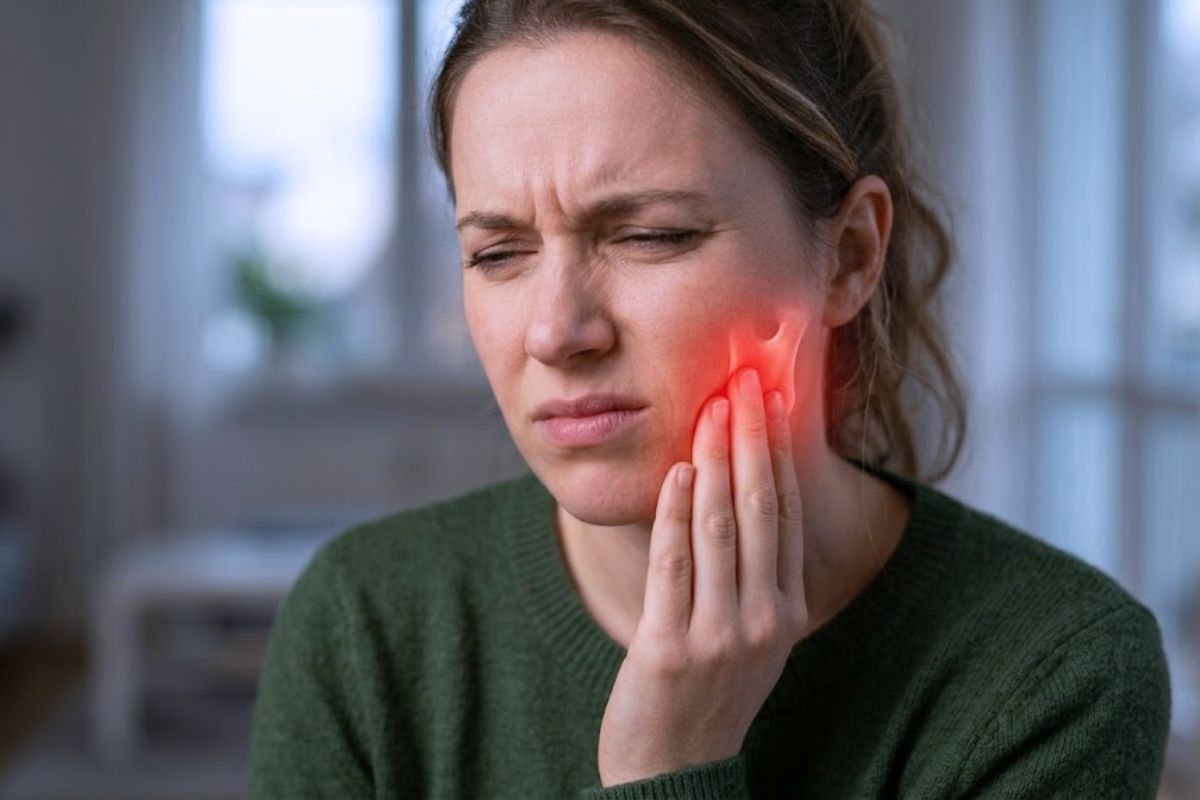
The surprising connection between gut health, inflammation and TMJ pain
I saw this interesting piece of research and thought it fitted so nicely with our holistic approach to health at The Perrymount Clinic. And it’s a rather unusual one too.
For starters, our osteopaths do treat jaw pain quite often. But I would think many people would not think to come to the osteopaths as their first line of treatment.
The temporomandibular joint (TMJ), the muscles of the jaw, the neck, posture, grinding and clenching can all contribute to temporomandibular disorders (TMD). From now on I’ll call the jaw joint the “TMJ”.
Increasingly, there is research suggesting that persistent jaw pain may not always be purely a mechanical problem.
There may be another piece of the puzzle much further away:
The gut. And considering we also love the quote “All diseases begin in the gut” this seems like it will make a very informative newsletter.
People with gut problems and TMJ pain frequently overlap
One of the strongest pieces of human evidence comes from a major US research programme called OPPERA — Orofacial Pain: Prospective Evaluation and Risk Assessment.
Researchers have been studying thousands of people to understand why some develop chronic jaw pain while others don't.
One striking finding is that TMD (jaw pain) frequently overlaps with other chronic pain conditions — including irritable bowel syndrome (IBS).
In an OPPERA analysis looking at TMD, IBS, headache, back pain and fibromyalgia, researchers found considerable overlap between these conditions rather than them simply occurring independently. Maybe you are seeing a pattern here. As they are all musculoskeletal disorders that are related to an inflammatory state. Which is what we mainly treat as osteopaths at The Perrymount.
That raises an interesting question.
Why should a painful jaw and an irritable bowel have anything to do with one another?
One possibility is that they share some of the same underlying mechanisms — including the nervous system, stress response, immune system and the way the brain processes pain. If you have read our past newsletters on gut health, you might be able to start to have an understanding of this.
But researchers are now investigating another possibility too:
The microbiome. Or Your GUT BACTERIA
Human genetics is pointing towards the gut microbiome
In 2024, researchers published a study specifically investigating the relationship between the gut microbiota and temporomandibular disorders.
Rather than simply comparing stool samples, they used a technique called Mendelian randomisation.
This uses naturally occurring genetic differences associated with particular gut bacteria to investigate whether those microbes might actually influence disease risk.
The researchers identified several groups of intestinal bacteria associated with increased or decreased susceptibility to TMD. These included Catenibacterium, Ruminococcus torques, Lachnospiraceae, Turicibacter and Peptococcaceae.
Then another human study appeared in 2025.
This one analysed microbiome genetic data from 18,340 people, alongside TMD data containing:
6,314 people with TMD
and
222,498 controls.
Again, researchers found evidence linking particular gut bacteria with TMD risk.
Most notably, Catenibacterium remained positively associated with TMD after replication analysis. Other organisms, including Oxalobacter, Ruminococcaceae NK4A214 and Senegalimassilia showed potentially protective associations.
This doesn't mean that one particular bacterium "causes TMJ”. And personally I’d forget the names of the bacteria as there isn’t much at the moment that can be done so specifically. But rather look at the overall picture that gut bacteria balance or good / bad bacteria makes a difference in jaw pain.
So how could your gut possibly affect your jaw?
Your intestinal bacteria aren't simply passengers living inside your digestive system.
They manufacture biologically active compounds that communicate with the rest of your body.
One particularly interesting group is called:
Short-chain fatty acids
These include:
Butyrate
Propionate
Acetate
And butyrate is attracting particular attention. We have supplements that add butyrate or promote butyrate production in the gut.
Certain intestinal bacteria manufacture butyrate when they ferment fibre in our diet.
Butyrate helps support the cells lining the colon and intestinal barrier, while also interacting with the immune and nervous systems.
This creates a potential chain of events:
Diet and lifestyle
↓
Gut microbiome
↓
Production of butyrate and other microbial metabolites
↓
Gut barrier and immune regulation
↓
Systemic inflammatory signalling
↓
Brain and nervous-system pain processing
↓
Potential influence on persistent pain
And that could include pain travelling through the trigeminal system, which carries sensory and pain information from the jaw and face.
And this is where the new butyrate research becomes fascinating
Very recent laboratory research has taken this one step further.
Researchers investigating inflammatory TMJ pain found lower levels of butyrate in the gut, circulation and nervous-system tissue of animals experiencing TMJ pain.
When researchers increased butyrate availability, pain sensitivity decreased.
They then examined more than 22,000 individual cells within an important trigeminal pain-processing region of the nervous system.
Butyrate appeared to influence the behaviour of neurons, immune cells and supporting cells involved in pain processing.
It changes how we might think about chronic TMJ pain
Perhaps the question shouldn't always be:
"What's wrong with my jaw?"
It might sometimes be:
"Why has my system become so sensitive that my jaw continues to hurt?"
There can still be a very real mechanical problem.
There may be tight masseters and temporalis muscles.
There may be grinding or clenching.
There may be cervical and postural involvement.
There may be irritation within the TMJ itself.
Those things need addressing and we can do that extremely effectively with osteopathy and TECAR or laser therapy.
But in somebody with persistent or recurrent TMJ pain, particularly when they also have IBS, bloating, digestive problems, widespread pain, headaches, poor sleep or high stress, it may make sense to look beyond and help the gut health too.
A more holistic approach to jaw pain
This is why at The Perrymount Clinic we don't necessarily see persistent pain as simply a problem with one painful structure.
With stubborn TMJ problems (or other chronic pain issues too), there may be several pieces of the puzzle.
We can assess and treat the jaw, muscles, neck and surrounding biomechanics.
But we can also ask questions about stress, sleep, nutrition, digestive health and inflammation.
It doesn't mean every person with jaw pain has a gut problem.
And it certainly doesn't mean that fixing the microbiome has been proven to cure TMJ disorders.
But the emerging research gives us another fascinating example of something naturopathic medicine has considered for a very long time:
Sometimes you have to look beyond the painful part.
The jaw may be where you feel the problem.
It isn't necessarily the only place influencing it.
We have a chronic pain package of 6 osteopathy treatments combined with laser or TECAR therapy for £390 which gives you a discount of £120. We also have our advanced bioresonance gut health scan available for £99. The details of this are below.
As always, if you have any questions please reply to this newsletter or call 01444 410944
The science behind this newsletter
The OPPERA human research programme has demonstrated substantial overlap between TMD, IBS and other chronic pain disorders.
Zhao and colleagues' 2024 human Mendelian-randomisation study identified several gut microbial groups genetically associated with TMD susceptibility.
A further 2025 study used microbiome data from 18,340 participants and TMD data from 6,314 cases and 222,498 controls, again finding evidence for a potential causal microbiome–TMD relationship.
Evidence level: The human evidence for an association between gastrointestinal health/microbiome characteristics and TMD is emerging but not yet strong enough to establish a clinical treatment protocol. Evidence specifically supporting butyrate supplementation for human TMD is currently lacking.