
When thoughts and emotions amplify pain

A few months ago we wrote a series of newsletters on chronic pain which generated a lot of interest and bookings into our chronic pain treatment course combining osteopathy and TECAR/laser therapy.
I read a really interesting article on pain this week and wanted to send it out, as it is from a holistic point of view which I hope by now you know we push at The Perymount Clinic. This research looked at an emotional angle to pain. In a holistic care to treatment emotions should be looked at. This can be approached from a nutritional/naturopathic point of view which we can cover in clinic too.
So here’s the newsletter: When thoughts and emotions amplify pain
Pain is real. However, pain is not simply a measurement of tissue damage.
The brain continually assesses information from the body alongside emotion, memory, stress, sleep, attention, and perceived danger. These factors can turn the nervous system’s “volume control” up or down.
A 2026 narrative review examined how pain catastrophising and emotions influence pain through identifiable neurological and physiological mechanisms. The authors concluded that negative emotions and catastrophic thinking may increase pain sensitivity, while positive emotions, relaxation and a greater sense of safety may help reduce it.
What is pain catastrophising?
Catastrophising does not mean that someone is being dramatic or inventing their pain. It describes an automatic pattern of thinking involving:
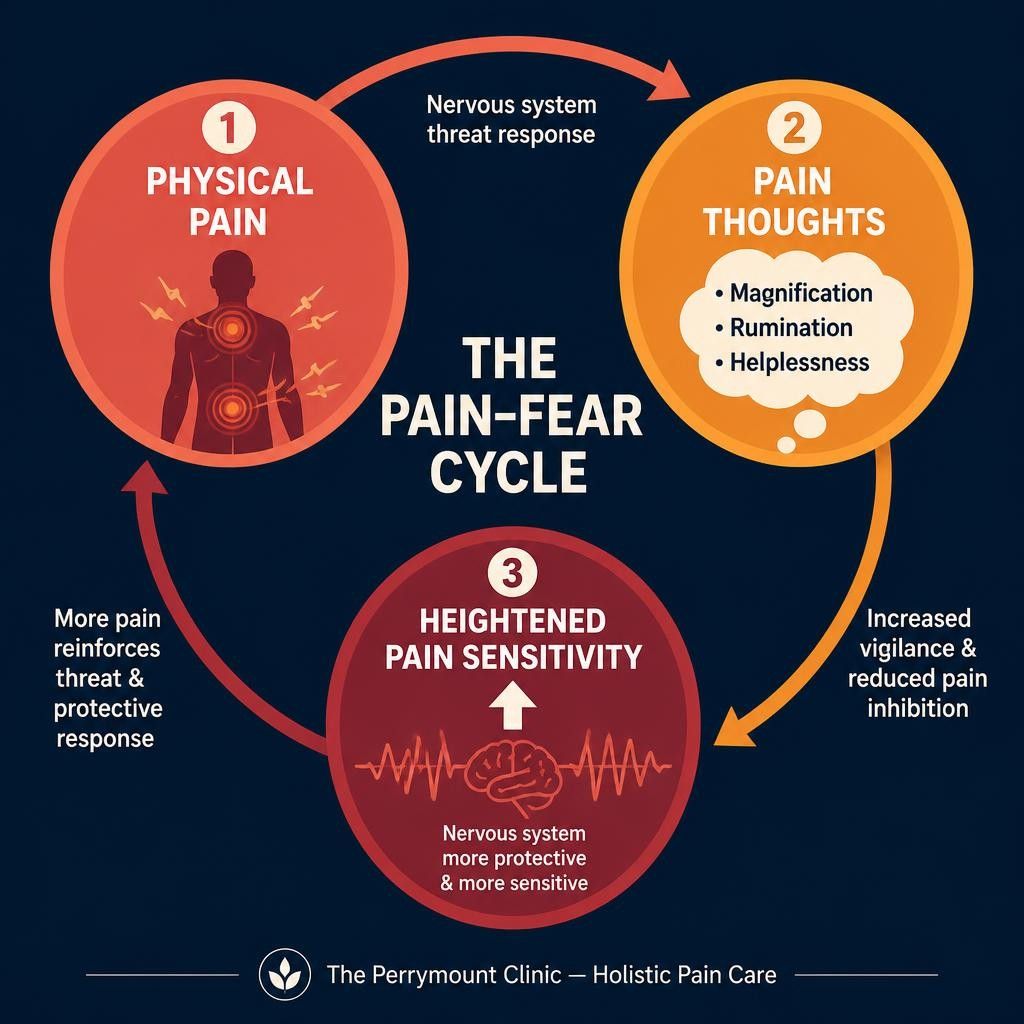
Magnification: “This pain must mean something is seriously wrong.”
Rumination: “I can’t stop thinking about it."
Helplessness: “There’s nothing I can do to improve this.”
These thoughts are understandable, particularly when pain is severe, unexplained or has continued for months. However, they can unintentionally increase the brain’s assessment of threat.
The pain–fear cycle
This cycle does not mean the original pain was psychological. A physical injury, inflammation, joint problem or nerve irritation may have started it. The important point is that the nervous system can subsequently become more protective and sensitive.
Physical pain -> Pain thoughts -> Maintained physical pain
How emotions can change pain
The review identified several overlapping mechanisms.
The stress response becomes more active
1. Fear, anxiety and helplessness can increase activity in:
✅ The sympathetic “fight-or-flight” system
✅ The hypothalamic–pituitary–adrenal, or HPA, stress axis
This can raise vigilance, muscle tension and sensitivity to bodily signals. The nervous system becomes better prepared to detect danger—but may also interpret normal or mildly uncomfortable sensations as threatening.
2. The brain pays more attention to pain
Catastrophising was associated with altered communication between the brain’s salience network and default mode network.
In simple terms, pain becomes increasingly:
✅ Important
✅ Difficult to ignore
✅ Connected to worry and self-focused thinking
✅ Likely to interrupt everyday activity
The more threatening the brain believes a sensation to be, the more attention it allocates to it.
3. Natural pain inhibition may become less effective
The body has its own pain-regulating systems, including endogenous opioids—natural chemicals that help dampen pain.
The review suggests that negative emotions and catastrophising may interfere with these descending pain-inhibitory mechanisms. It is therefore not just that someone thinks about pain more; their physiological resistance to pain may also be reduced.
4. Positive emotions may produce the opposite response
Positive emotional states were associated with:
👍 Increased parasympathetic “rest-and-recover” activity
👍 Reduced threat perception
👍 Greater endogenous opioid activity
👍 Reduced pain intensity
This does not mean that patients should simply “think positively.” Forced positivity can feel dismissive. The clinical aim is to gradually create genuine experiences of safety, control, progress and confidence.
Why movement can sometimes hurt without causing harm
With persistent pain, the nervous system may begin to predict danger during particular movements. Pain can then appear before—or without—new tissue damage.
Complete avoidance may reinforce the brain’s conclusion that the movement is dangerous. Over time, this may contribute to:
👎 Loss of strength
👎 Reduced mobility
👎 Increased stiffness
👎 Lower confidence
👎 Greater sensitivity when movement is attempted again
Graded movement provides the nervous system with new evidence:
“I can perform this movement safely, and discomfort does not necessarily mean damage.”
This needs to be appropriately paced. The objective is neither total avoidance nor pushing through severe pain, but gradually expanding what feels safe and manageable.
Practical ways to turn down the pain alarm
The review highlights several potentially useful approaches:
✅ Pain education
✅ Cognitive behavioural therapy
✅ Mindfulness
✅ Breathing and relaxation exercises
✅ Yoga or gentle controlled movement
✅ Improving coping strategies
✅ Identifying fearful or catastrophic thoughts
✅ Focusing attention on achievable improvements
✅ Gradually rebuilding movement confidence
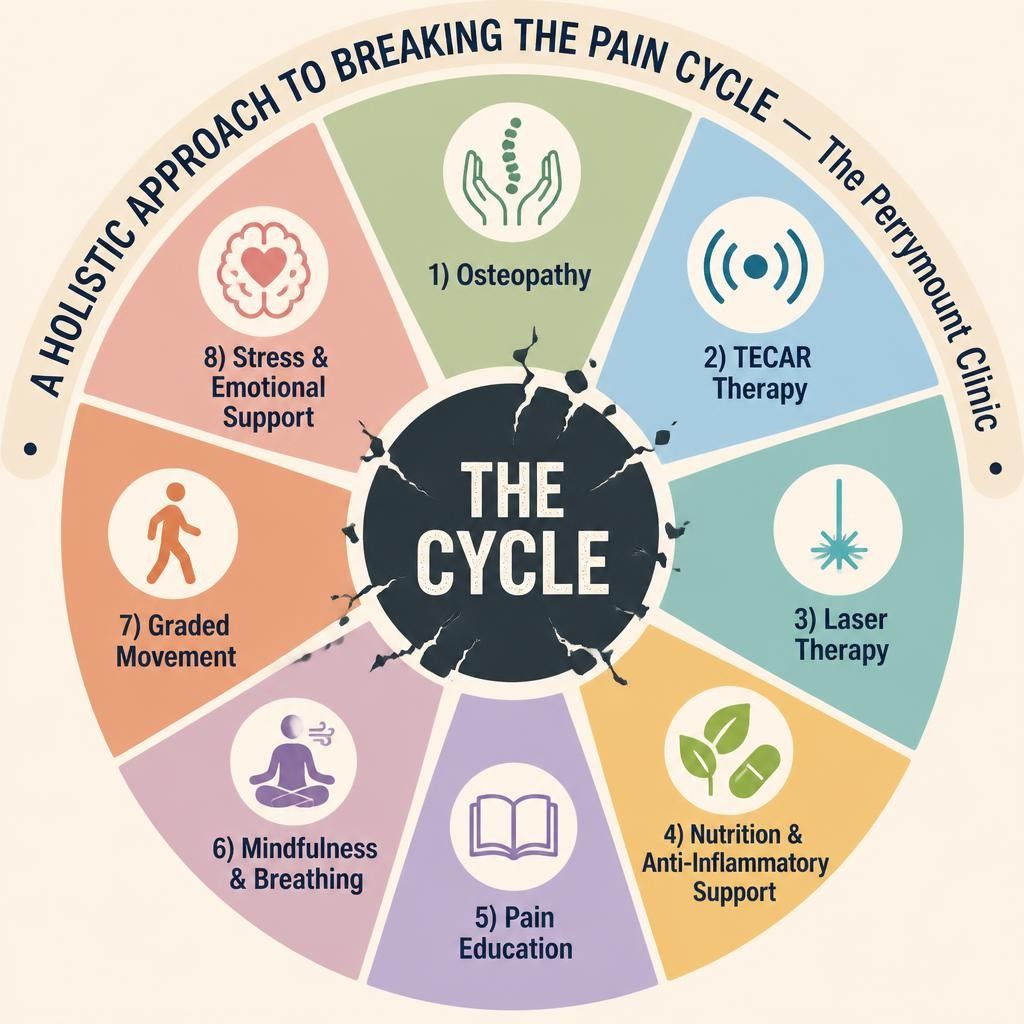
From our point of view at The Perrymount Clinic we have a fantastic offering combining manual therapy; osteopathy with advanced technology in the form of TECAR radiotherapy and laser therapy. Also naturopathic nutritional scanning to look at anti-inflammatory supplements and supplements that support stress. Finding food intolerances that contribute to inflammation would also be a great addition to a holistic approach.
The osteopathy would provide a useful way for improving movement by reducing symptoms, improving mobility and offering reassuring sensory input. The longer-term goal is to combine symptom relief with active rehabilitation and increased confidence.
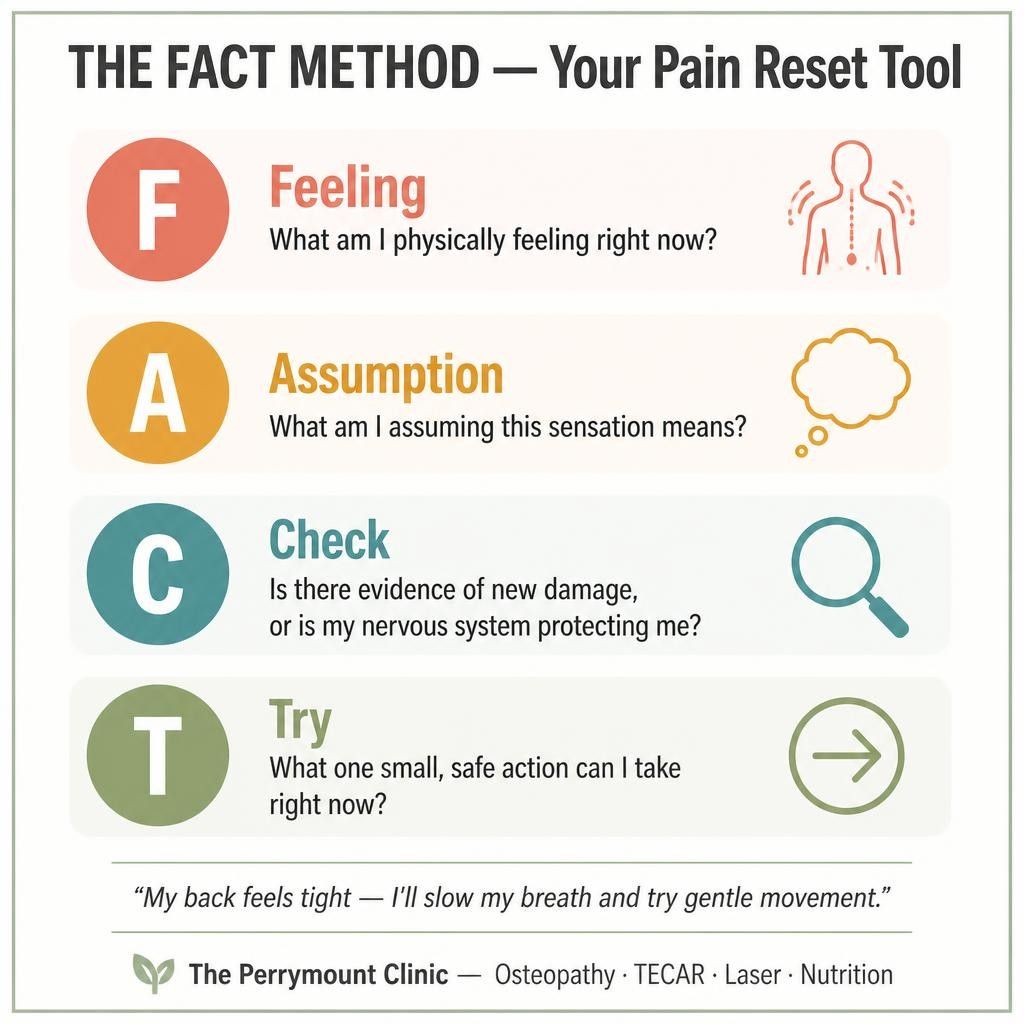
A simple patient exercise: FACT
When pain increases, ask:
F — Feeling: What am I physically feeling?
A — Assumption: What am I assuming that sensation means?
C — Check: Is there evidence of new damage, or could my protective system be reacting?
T — Try: What small, safe action could I try now?
For example:
“My back feels tight. My immediate assumption is that I have damaged it again. However, I have not fallen or sustained a new injury. I will slow my breathing and try two minutes of gentle movement before deciding what to do next.”
New, rapidly worsening or unexplained symptoms should still be medically assessed.
Important interpretation of the research
This was a narrative review, not a new clinical trial or systematic meta-analysis. It brings together biological and psychological research to propose plausible mechanisms, but it cannot prove that changing emotions will resolve every person’s pain.
The strongest and most balanced conclusion is:
Thoughts and emotions are not necessarily the original cause of pain, but they can influence the nervous system processes that determine how strongly pain is experienced.
We would add:
Physical treatment, like our chronic pain course using osteopathy / TECAR radiotherapy / laser therapy can successfully reduce your pain and lower the nervous system feedback to you. Which then decreases the emotional influence back to the physical pain. And so the negative pain cycle can gradually be slowed.